Hypolimnus bolina jacintha
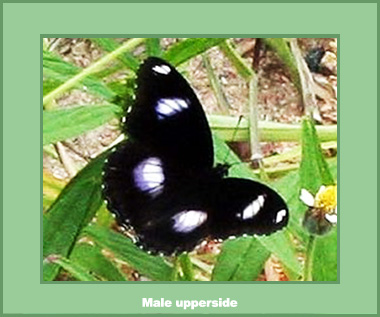
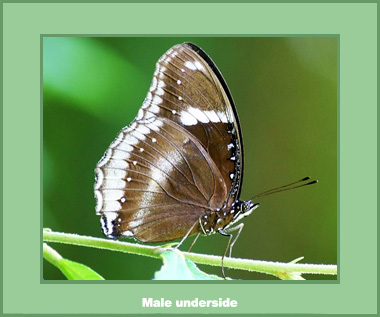

Drury 1773 - The Great Eggfly
Koh Samui and Koh Pha Ngan.
A fascinating species. In Peninsular Thailand and Malaysia, H. b. jacintha is the predominant subspecies, but there are occasional invasions of a second subspecies, H. b. bolina, which is smaller. These two subspecies interbreed and produce innumerable intermediate forms. The latter subspecies lacks the white postdiscal and submarginal spots, and its most common female form, f. nerina (not pictured), has an orange patch on its forewing.
The species is common on both islands, and can be found in gardens and secondary growth. The males are highly territorial, and will not hesitate to chase away any other butterfly which approaches too close. It has also been known to try and ward off other animals, including humans. It will always return to its favourite perch after its assault.
Flight Period
| Jan | Feb | Mar | Apr | May | Jun | Jul | Aug | Sep | Oct | Nov | Dec |
| x | x | x | x | x | x | x | x | x | x | x | x |
Wingspan
50 - 85mm
Early Stages
Fully known. More detailed life history information is available from the following resource: ButterflyCircle Blog (courtesy of Dr. Horace Tan.)
Larval Foodplant
As could be expected for a species with such a large range, this species feeds on a large number of plant species from many different plant Families. In Thailand, it has been seen to feed on Alternanthera ficoides and Alternanthera sessilis (both Amaranthaceae), Asystasia gangetica (Acanthaceae), Commelina diffusa (Commelinaceae), Eclipta prostrata and Synedrella nodiflora (both Compositae), Ipomaea aquatica and Ipomaea pes-caprae (both Convulvulaceae), Lens esculenta (Papilionaceae) and Sida rhombifolia (Malvaceae).
Range
Mainland Thailand and Indo-China. Other subspecies throughout the remaining area of Madagascar (not mainland Africa) to China, Australia and many Pacific Islands.